


While the halls of Brussels echo with discussions over regulations, the rest of the world is racing ahead. Artificial Intelligence (AI) and robotics, led predominantly by China and the United States, are not waiting for parliamentary consensus or multi-year policy frameworks. The planet is being reshaped in real time, and the balance of global power is shifting toward those who embrace technological disruption rather than delay it.
Regulatory Paralysis vs. Technological Momentum
The European Union prides itself on its meticulous legislative process, ensuring that every policy is robust, protective, and fair. However, this very thoroughness can be a double-edged sword. By the time a regulation is finalized, the underlying technology it seeks to govern has often already evolved beyond recognition. In sectors like AI, where innovation cycles move at the speed of months rather than years, Europe risks becoming a perpetual follower rather than a leader.
Meanwhile, across the Atlantic, the United States continues to advance its AI ecosystems, supported by a vibrant venture capital environment and a concentration of world-leading tech companies. China, however, may be the true disruptor. With a state-driven vision and aggressive industrial policies, it is pouring unprecedented resources into robotics, automation, and AI. The Chinese government views these fields not merely as industries but as strategic pillars of national security and economic dominance.
China’s Leap in Robotics
Over the past decade, China has transitioned from being the “world’s factory” to the world’s testing ground for advanced robotics. From autonomous delivery vehicles in urban centers to AI-powered manufacturing robots, the pace of adoption is staggering. State subsidies and long-term industrial plans have accelerated this growth. Chinese companies like DJI dominate the global drone market, while robotics firms such as UBTECH and Fourier Intelligence are pushing humanoid and service robots into commercial use.
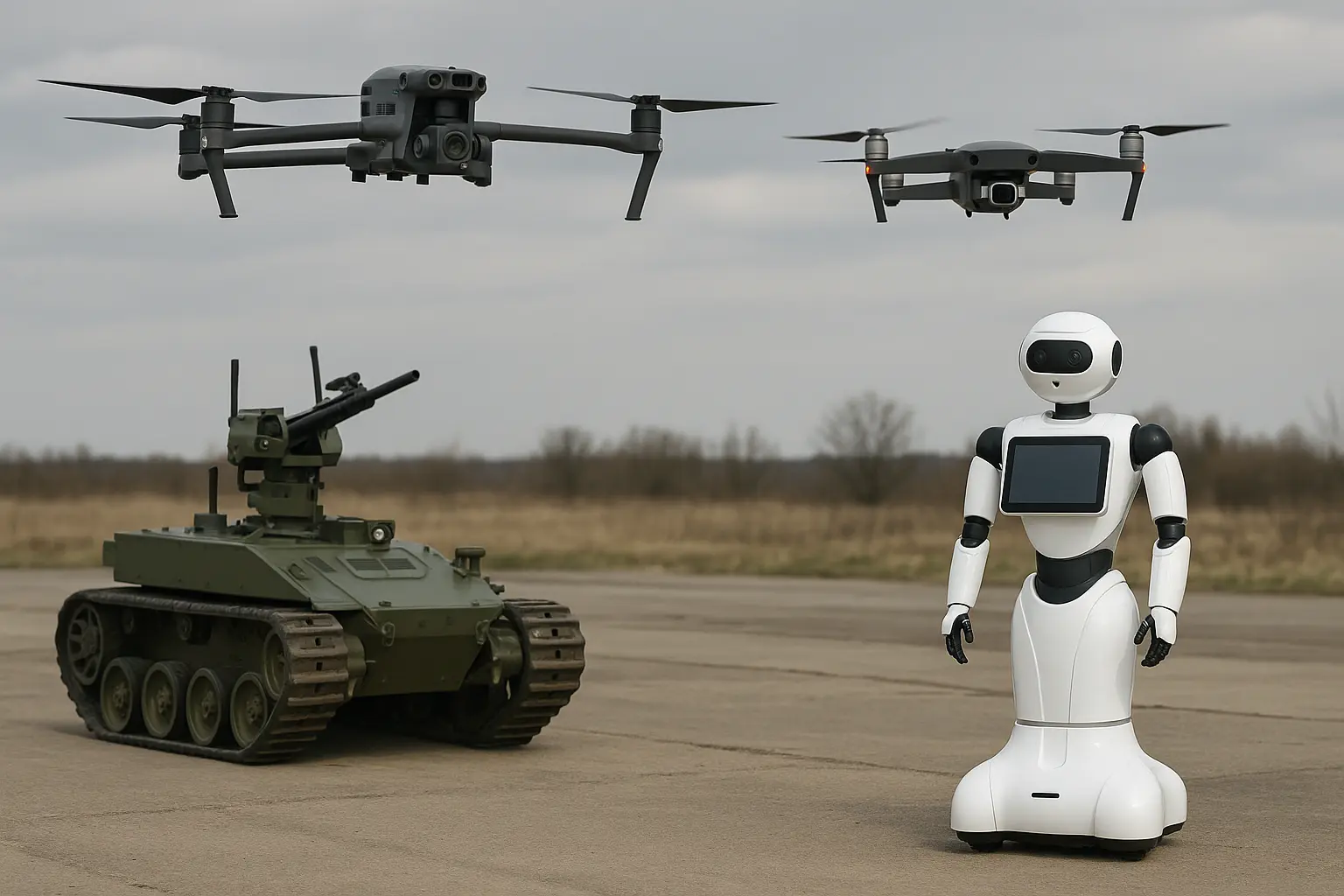
This progress is not limited to civilian industries. China’s military modernization strategy explicitly incorporates robotics and AI into its future combat doctrines. In simulated exercises and field tests, autonomous systems are being integrated with human forces to create hybrid combat units — a reality that many Western militaries are still merely theorizing about.
3D Printing + AI: Factories Without Borders
One of the most transformative technological synergies emerging today is the combination of AI with 3D printing. This pairing is paving the way for a new era of decentralized manufacturing — effectively, personal factories. AI can design and optimize products instantly, tailoring them to the user’s needs, while 3D printing can bring these designs to life anywhere in the world.
This model eliminates the need for traditional supply chains, middlemen, and even geographic constraints. A small business in Nairobi could design and print components that rival those produced in a factory in Shenzhen. This democratization of production could disrupt everything from consumer goods to aerospace manufacturing, reducing costs and increasing speed. For countries that move quickly, the potential economic advantage is enormous. For those that hesitate, the consequences could be equally severe, as industries migrate toward more agile ecosystems.
The Battlefield Revolution
Perhaps the most visible — and chilling — example of this technological transformation is found on the modern battlefield. In Ukraine, autonomous drones and robotic systems are rewriting the rules of war. Russian forces, having invested heavily in drone technology, now deploy swarms of unmanned aerial vehicles (UAVs) for reconnaissance, targeting, and even direct attacks. These systems are faster, more precise, and less vulnerable than their human counterparts.
Reports from the front lines suggest that Ukrainian soldiers have, on occasion, surrendered to autonomous machines — an unprecedented development in military history. Such events mark a profound shift in the ethics and psychology of warfare. When machines can make independent targeting decisions, the very nature of combat — and the laws that govern it — are called into question.
Europe’s Strategic Crossroads
Europe now finds itself at a critical juncture. On one hand, its regulatory frameworks — particularly those concerning privacy, human rights, and ethical AI — are admired worldwide. On the other, its slow-moving bureaucracy risks leaving the continent technologically dependent on powers with very different priorities and values.
The debate in Brussels often centers on ensuring that innovation is safe, ethical, and inclusive — goals that are undeniably important. Yet, in a world where geopolitical power increasingly flows to those who master AI and robotics, safety without competitiveness could lead to strategic irrelevance. The gap between regulators and innovators is widening, and Europe must decide whether to close it or accept a subordinate role in the technological hierarchy.

The Future Will Not Wait
The harsh reality is that the future does not wait for consensus. Technological revolutions are rarely patient, and the global race for AI and robotics supremacy is already well underway. Those who stand still — or move too cautiously — will find themselves “out of the game,” not by choice but by circumstance.
In the coming decade, the winners will be those who balance innovation with governance, speed with safety, and ambition with responsibility. This requires not only investment in research and development but also a cultural shift — one that embraces calculated risk-taking and accelerates the transition from concept to application.
Europe has the talent, the academic infrastructure, and the industrial heritage to compete at the highest level. What it lacks is the urgency and the political will to match the pace set by China and the United States. The question is no longer whether AI and robotics will dominate the global economy and redefine geopolitics — they already are. The question is whether Europe will be a driver of this transformation or a passenger.

He uses to dedicate part of his life to inspire others and help them achieve the most out of their lives. Since he was 20, he had successfully founded and managed several companies operating in the field of management consulting, wealth management and fintech. He is Member of Institute of Directors in London, Member of Changer Club in Riga, Member of Fintech Association of Hong Kong, Member of Singapore Fintech Association, Member of Non Executive Director Association in London and Member of Alumni Network of Draper University in San Francisco. He loves travelling, he is a cigars lover, an amateur golfer and a dapper man.
DO YOU NEED MY TEAM HELP?
Please write me an email with your specific case, my team will be more than happy to help you to find the best solution for your business need or to advice and support you to start a new business venture.
Contact me
DO YOU WANT TO JUMP INTO A ONE-ON-ONE CALL WITH ME?
Take your chance to learn from who have done most of the stuff he is talking about for himself and he knows what works – and what doesn’t – in the real world.

Book a Wake Up Call with me, if you are moving the first steps in the business world and you wish to learn how to get started!
Wake up callBook a Check Up Call with me, if you are already in business and you wish to check up your business and leverage my experience to improve your structure or expand your business.
Check up call
